
India also went on an overdrive in expanding its military engagement with like-minded countries in its neighbourhood and beyond in the face of China's relentless attempts to become a regional hegemon and establish its primacy in South Asia.

There are two ways: Deliver a rapidly growing economic pie or reform GST and close corporate tax loopholes, suggests T N Ninan.

The supplementary demands for grants include a gross additional spending of over Rs 2 lakh crore, which would be matched by savings of over Rs 1.21 lakh crore.

'Expectations are high regarding the change in LTCG with respect to equity investments.'
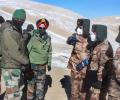
Lou also spoke about China's tensions with neighbouring countries without directly mentioning the eastern Ladakh border standoff with India since May 2020 which resulted in the Galwan Valley clash in June of that year.

Finance Minister Nirmala Sitharaman on Tuesday unveiled a Rs 39.45 lakh crore Budget with a view to fire up the key engines of the economy to sustain a world-beating recovery from the pandemic. This was Sitharaman's fourth Budget. While the taxpayers were left in the lurch, once again, was she able to cheer Corporate India?

There is nothing to be worried about as bilateral ties are robust with solid foundations. Both are on the same page on the economic and defence/security ties bilaterally and globally and that shall continue irrespective of change in political dispensation in either country, points out Dr Rajaram Panda.

"A mere 5-6 per cent of defence budget for R&D is inadequate to meet the aspirations of India's defence needs especially when China spends about 20 per cent of their defence budget for R&D," said the DRDO chief.

In what is seen as a significant move, the DAP featured measures to reduce delay in procurement of essential items by the three services as it proposed a new enabling provision to acquire them through capital budget under a simplified procedure in a time-bound manner.

Finance Minister Nirmala Sitharaman presents her fourth Budget in Lok Sabha on Tuesday.
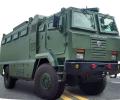
'We see the defence industry as one of the leading sectors, which will significantly contribute to the growth of the Indian economy, but more importantly, bring atmanirbharta to national security.'
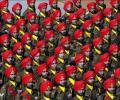
The finance minister hiked the total defence expenditure from Rs 203,672 crore in FY 2013-2014 to Rs 229,000 crore for FY 2014-2015. Though the increase appears substantial, it is insufficient to undertake the military modernisation necessary to meet the emerging threats, feels Brigadier Gurmeet Kanwal (retd).

'There are ominous portents of an isolationist administration not only building a physical wall to the south to prevent unwanted immigrants from entering the land of milk and honey, but also trade walls not just against China, but all nations,' foresees Sreekant Sambrani.

'We will prioritise our requirements so that the country's maritime interests are not compromised.'

Amid FY23 Union Budget's focus on investments, leading domestic credit rating agency Crisil on Wednesday said that the capital expenditure is "not as high as it sounds". It, however, was quick to add that considering that governments usually tend to cut capex during a crisis, the government has maintained its focus on growth-spurring initiatives amid the pandemic. The research wing of the agency said, if one excludes the Rs 1 lakh crore of loans to states for capex included in the headline figure of Rs 7.50 lakh crore or 2.91 per cent, the actual spend in FY23, will go down to 2.58 per cent of GDP, which is barely at par with the revised estimate of FY22.
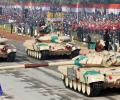
'Russia has got inherent military strength, they have a very good military equipment manufacturing infrastructure and by and large they are self-sufficient in their production capabilities'

Budget has already bombed at the box office and passing it without a revisit will be a mockery of the exercise though any modification may be short lived and perfunctory, observes V Ranganathan.

The central government's Great Nicobar development project, proposed around an unprecedented transhipment port, will be executed to keep environmental impact minimal, and is essential as it is of national importance, the government has said amid calls to abort the controversial project due to ecological concerns, the Centre said in an official statement.
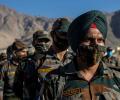
The political-electoral calculus favours spending thousands of crores on vanity projects like Sardar Patel's statue and the Central Vista over building up our military to handle the confrontations and conflicts that loom large, points out Ajai Shukla.

'China is struggling to get out of its property bubble.' 'Japan took 35 years to walk out of its equity bubble.' 'Bubbles can be difficult to forecast.'
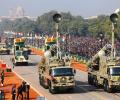
India is one of the largest military equipment importers in the world, at over $8 billion a year.

A combination of factors, including heavy investments in US Treasury bonds and dollar sales at a healthy profit, facilitated the Indian central bank in transferring a record surplus of Rs 2.11 trillion to the government for 2023-24 (FY24). The RBI's dollar purchases increased in FY24, supported by robust capital inflows endorsing the economy's health.
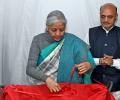
The interim Budget proposals that will be presented on February 1 in the backdrop of the general elections scheduled in April/May 2024 are likely to have a hint of populism, believe analysts, but are unlikely to derail the government from its path of fiscal prudence.

It is the first time that Biden has made such a statement, adding that the weapons sent could also be used in the operation to target the population centres.

'He consulted widely, both formally and informally and acted quickly on pragmatic suggestions.' 'To his credit, Parrikar took the initiative to reduce excessive litigation against armed forces veterans and widow over small sums of pensionary and disability benefits,' points out says Brigadier Gurmeet Kanwal (retd).
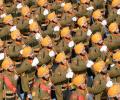
Rs 111,294 crore has been allocated for army salaries. The Rs 113,278 crore allocated for army pensions surpasses that. Army planners are worried about this drain on funds that could otherwise go towards equipment modernisation.

Budget for 2022-2023 has returned to its agenda for protectionism in the name of creating a self-reliant India, points out A K Bhattacharya.

'Increased allocations for MNREGA could have provided the much needed push to rural demand and consumption at a time when recovery continues to remain uneven.'

Most brokerages are betting that the new government will shift to a policy focussing on boosting rural incomes and consumption since that has clearly been a pain point.

PSU divestment, LIC IPO, fiscal deficit: Budget 2021 marks a clear change in the Modi government's stance from fiscal conservatism to growth orientation.

In an address at the Navy Commanders' Conference, he said 'jointness' in operations will be critical in any future wars and restructuring of military commands and establishment of theatre commands is the way ahead.

India's doctrinal policy shift in combating terror by carrying out the Balakot air strikes inside Pakistan, appointment of a Chief of Defence Staff and hastening work on military modernisation marked a new beginning in 2019 in dealing with complex security challenges.

Nobody bothered to articulate the upsides; instead, the four-year tour of duty and denial of life-long pensions got played up.
Job-seekers for government and related opportunities found that their future was at risk, points out Shreekant Sambrani.

India is one of the largest defence importers.

If military power is all it would take to finish the menace of an awful terrorist organisation like Hamas, how come five Israeli wars in Gaza since 2003 have failed to do so? asks Shekhar Gupta.

Engagement with neighbours is a strategic imperative, and not an option, asserts Rup Narayan Das.
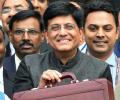
Here are the key highlights of the Interim Budget 2019-20 presented by Finance Minister Piyush Goyal in the Lok Sabha on Friday.

The government told an all-party meeting Monday that it does not intend to bring any legislative business in Rajya Sabha during the first part of the Budget Session which is till February 11, sources said.

I am happy I didn't knock anyone down, driving recklessly or trying to show off. However, in one instance of road rage (the consequence of arguing with a driver who disrespected my right to cross the road peacefully) I did find a man in a SUV taking his anger out on me by driving his vehicle over my feet, recalls Shyam G Menon.
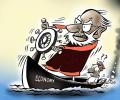
Economic growth, which we are taking for granted, slows for a completely different set of local or global factors and the Modi premium vanishes, observes Debashis Basu.
 © 2026 Rediff.com - Advertise with us - Disclaimer - Privacy Policy - Sitemap - Feedback - About us - Terms of use - Grievances